Current Transcript
00:00 – 01:15

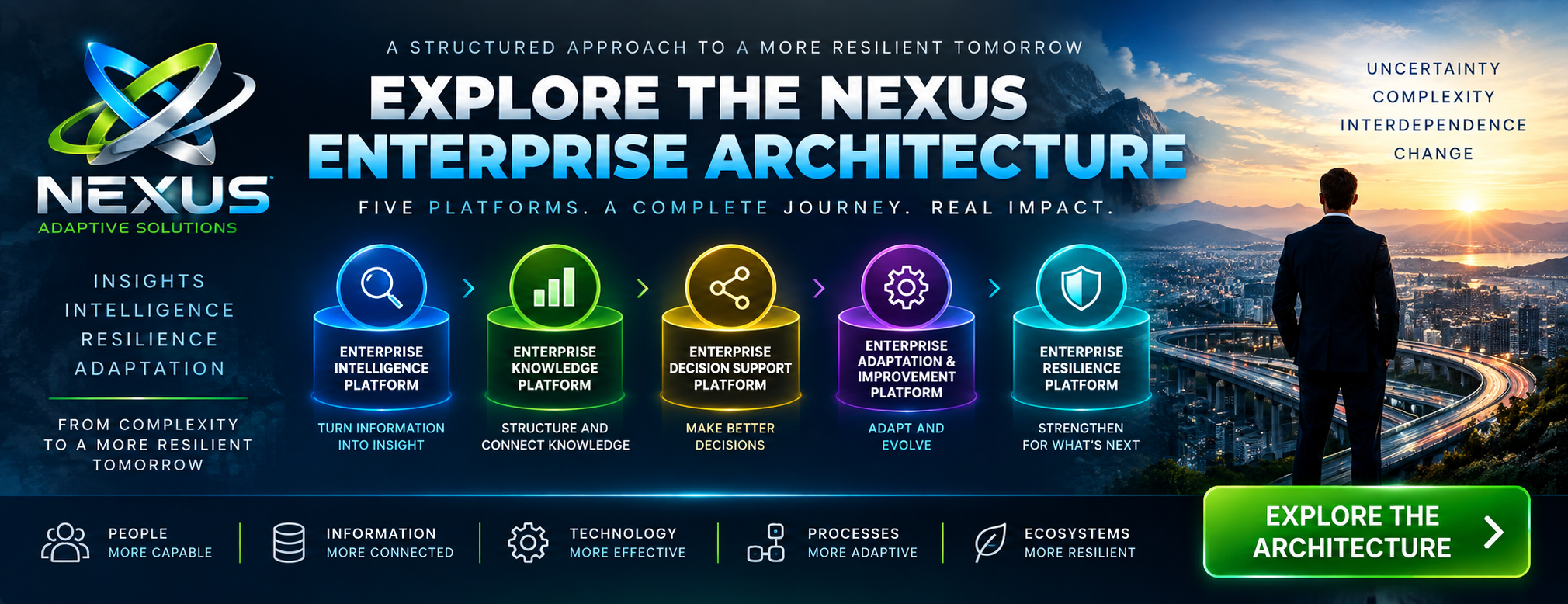
Welcome to Adaptive Operations, the podcast from Nexus Adaptive Solutions, where we explore how organizations can navigate complexity, uncertainty, and change in an increasingly dynamic world. I'm Alan. Whether you're an executive, manager, business owner, consultant, or operational leader, if you've ever felt that running an organization has become more complicated, less predictable, and harder to plan for than it used to be, you're in the right place. This episode is the first in our series on modern organizational resilience and adaptive leadership, and today's episode is called The New Operational Reality, Part One: The End of Stable Operating Environments.
For decades, many organizations operated in environments that were relatively stable and predictable. Leaders could create long-term plans, forecast future conditions with reasonable confidence, and expect that the assumptions behind those plans would remain valid for years. Today, that reality is changing. Organizations now face accelerating technological change, increasing interdependence, evolving customer expectations, workforce transformation, regulatory complexity, cybersecurity threats, and growing operational uncertainty. The result is an operating environment where change is no longer an occasional disruption. It has become a permanent feature of organizational life.
But this episode isn't about predicting the future, and it's not about presenting another framework that promises certainty in an uncertain world. Instead, we're going to step back and ask a more fundamental question: What has changed about the environment organizations operate in, and why are so many traditional leadership and management approaches being challenged? We'll explore why stable operating environments are becoming increasingly rare. How digital transformation and interconnected systems have fundamentally changed organizational dynamics and why complexity is reshaping the challenges leaders face every day.
We'll also examine why organizations are becoming more dependent on external systems, technologies, suppliers, and partners, why change cycles continue to accelerate, and why uncertainty is becoming a permanent feature of modern operations rather than a temporary disruption. From there, we'll explore what these shifts mean for leaders. How should planning change when assumptions expire faster than ever before? How do organizations remain effective when certainty becomes increasingly difficult to achieve? And what signals indicate that an organization may be struggling to adapt to its changing environment? Most importantly, we'll introduce a central idea that will guide this series.
The greatest challenge facing modern organizations is not simply managing change, it is learning how to operate effectively when change, complexity, and uncertainty become normal operating conditions. Because once leaders understand that reality, something important happens. The conversation shifts away from predicting every future event. It shifts away from trying to eliminate uncertainty, and it shifts towards building organizations that are resilient, adaptable, and capable of succeeding across a wide range of possible futures. By the end of this episode, you won't have a simple checklist or a set of quick fixes, but you'll have a clearer understanding of why today's operating environment feels fundamentally different from the past,
why traditional assumptions are being challenged, and why adaptability is becoming one of the most important organizational capabilities of the modern era. So let's begin at the beginning. What exactly has changed about the world organizations operate in, and why does it feel like stability itself is becoming harder to find? But before we explore that question, let's take a break and hear from our sponsor. Used to be the future moved nice and slow. Leaders made plans and watched them grow. Markets changed over years, not weeks. Patterns stayed steady underneath. Businesses built around what they knew. Historical trends carried people through. Forecasts felt reliable back then,'cause tomorrow looked a lot like now again.
Growing an e-commerce business is one thing. Scaling it profitably is something else entirely. The Boost Group helps ambitious e-commerce brands accelerate growth through performance-driven paid advertising. Their specialists manage campaigns across the major advertising channels, building an omni-channel strategy designed to increase sales while protecting profitability. From campaign strategy and creative execution to ongoing optimization, the Boost Group takes care of the advertising, allowing you to stay focused on running and growing your business. And their approach is built around performance. If they don't achieve the agreed targets, they work for free. So if your e-commerce business has reached a plateau, are you ready to take growth to the next level? Discover what the Boost Group can do for you. Visit theboostgroup.io to book a free strategy call today.
But something's shifted across the land. Change started moving faster than planned. Now every industry, every team, waking up inside a different scene. Technology move before people adapt. One disruption spread across the map. And the old assumptions people knew don't always carry organizations through.
Welcome back. But first, let's come back to the question we left you with in our first executive briefing accompanying this episode. The question is, if uncertainty, complexity, interdependence, and rapid change are becoming permanent features of modern operations, what leadership model will replace the traditional command and control approach? The leadership model most likely to replace the traditional command and control approach is adaptive leadership. This is a model focused on helping organizations navigate change, uncertainty, and complexity rather than attempting to control every outcome.
In a world where conditions evolve rapidly and information is constantly changing, leaders can no longer succeed simply by directing activities from the top of a hierarchy. Instead, they must create organizations that are capable of learning, adapting, and responding effectively at every level. For more than a century, command and control leadership was highly effective because it was designed for a different environment. Organizations typically operated in conditions that were more predictable, more stable, less interconnected, slower-moving, and easier to forecast. In such environments, leaders could gather information, analyze it centrally, make decisions, and communicate instructions throughout the organization.
Success depended largely on effective execution and compliance with established plans. Today's environment is fundamentally different. Modern organizations face challenges that are complex rather than merely complicated, dynamic rather than stable, interconnected rather than isolated, and uncertain rather than predictable. No single leader, regardless of experience or expertise, can possess all of the information needed to make every important decision. Critical information is often distributed throughout the organization, residing with frontline employees, specialists, customers, suppliers, and partners. As a result, leadership must evolve from controlling information to enabling effective responses.
The question is no longer, how can leaders make all the important decisions? Instead, it becomes, how can leaders create an organization that makes good decisions at every level? At its core, adaptive leadership recognizes that uncertainty cannot be eliminated. Future conditions cannot always be predicted. Problems cannot always be solved through expertise alone, and unexpected challenges will continue to emerge. Because of this, adaptive leaders focus on helping their organizations navigate uncertainty rather than pretending it can be removed. Their role becomes less about providing answers and more about helping people ask better questions.
They help organizations recognize emerging changes, understand shifting conditions, learn from experience, adapt strategies when necessary, and remain aligned despite uncertainty. In essence, adaptive leaders help organizations stay effective even when the future remains unclear. Traditional leadership often emphasizes authority. Adaptive leadership emphasizes capability. Rather than asking, How can I solve this problem? adaptive leaders increasingly ask, How can I help the organization solve this problem? This means building capabilities such as critical thinking, collaboration, learning, innovation, resilience, and decision-making.
The goal is to create an organization that does not depend on a few leaders for success but is capable of responding effectively throughout the system. One of the defining features of adaptive leadership is distributed decision-making. In fast-changing environments, information often becomes outdated before it can travel through multiple layers of hierarchy. Adaptive leaders recognize that people closest to the situation frequently have the best information. As a result, they empower teams to make decisions, solve problems, respond to customers, and address emerging issues. This does not mean abandoning accountability. Instead, leaders provide clear priorities, shared goals, decision-making frameworks, and strategic direction.
Within those boundaries, teams have the authority to act. This increases organizational responsiveness and decision velocity. Traditional leadership often focused on planning and execution. Adaptive leadership places equal emphasis on learning Because future challenges cannot always be predicted, organizations must become skilled at learning as conditions evolve. Adaptive leaders encourage experimentation, feedback, reflection, continuous improvement, and knowledge sharing. They understand that the organization that learns fastest often adapts fastest. In uncertain environments, learning becomes a competitive advantage. Traditional leadership often seeks to simplify problems and create clear solutions.
Adaptive leaders recognize that many challenges are complex and may never have a single correct answer. For example, organizational culture, workforce engagement, sustainability, digital transformation, and innovation. These challenges involve multiple interconnected factors and evolve continuously over time. Adaptive leaders focus on managing these dynamics rather than attempting to force simple solutions onto complex realities. As organizations become more distributed and interconnected, trust becomes increasingly important. Adaptive leadership relies on transparency, communication, shared purpose, and mutual accountability. Employees must feel trusted to make decisions.
Leaders must trust teams to act responsibly. Organizations that build strong trust often respond more effectively during periods of uncertainty because information flows more freely and people are more willing to take initiative. Perhaps the most useful way to think about adaptive leadership is to compare two roles. A traditional leader acts as a commander. An adaptive leader acts as an architect. The commander directs activity. The architect designs the environment within which activity occurs. Adaptive leaders focus on creating systems, cultures, structures, and capabilities that allow the organization to succeed even when circumstances change unexpectedly.
Their success is measured not by how many decisions they personally make, but by how effectively the organization functions without requiring constant direction. As uncertainty and complexity continue increasing, future leadership is likely to be characterized by adaptability over control, learning over certainty, empowerment over hierarchy, collaboration over silos, resilience over optimization, and capability building over command. The organizations that thrive will not necessarily have leaders who can predict every challenge. They will have leaders who can help their organizations respond effectively to whatever challenges emerge.
The key takeaway is this: the leadership model replacing traditional command and control is adaptive leadership. Rather than focusing on directing every action, adaptive leaders build organizations that can learn, adapt, collaborate, and make effective decisions in the face of uncertainty. In an increasingly complex and unpredictable world, leadership success will depend less on controlling outcomes and more on enabling organizational adaptability. The future belongs not to leaders who have all the answers, but to leaders who can build organizations capable of thriving when no one has all the answers.
Throughout this series, we'll be exploring how leaders can navigate complexity, strengthen resilience, and build organizations capable of thriving amid uncertainty. But before we discuss solutions, we first need to understand the environment those solutions must operate within. Because if the rules of the game have changed, leadership must change with them. So let's get started. For much of modern business history, organizations operated with a relatively simple assumption. The environment around them would change, but usually slow enough for leaders to understand what was happening, make decisions, and respond.
Markets evolved, technology advanced, customer expectations changed, and competition increased. But those changes often happened gradually enough that organizations had time to adapt. That gave leaders something extremely valuable, a reasonable degree of predictability. They could develop long-term strategies, build annual operating plans, forecast demand, allocate resources, make major investments, and do all of those things with reasonable confidence that the conditions surrounding those decisions would remain broadly recognizable for long enough to execute them.
So when we talk about the disappearance of stable operating environments, we're not saying organizations once operated in a world where nothing changed. Change has always existed. The difference was the relationship between change and time. Organizations generally had time to observe what was happening, understand its implications, decide how to respond, and implement that response before conditions changed significantly again. Today, that relationship is becoming much less dependable Organizations can still be responding to one development when another begins to emerge. A strategic decision can still be moving through implementation when the conditions supporting it begin to shift.
A technology can be entering the organization while newer capabilities are already beginning to change expectations. The operating environment hasn't simply become different. It has become much more difficult to assume that today's conditions will remain in place long enough for traditional responses to run their course. And that's really what we mean when we say stable operating environments are disappearing. It's not the disappearance of stability altogether. It's the decline of stability as a dependable assumption. To understand why that matters, it's useful to look at how operating environments were different in the past. Historically, many industries evolved relatively gradually.
Competitive landscapes were often easier to understand. Technology cycles were longer. Customer behavior changed more slowly, and organizations could often develop strategies around patterns that had remained consistent for considerable periods of time. A five-year strategic plan obviously contained uncertainty, but there was a reasonable expectation that many of the assumptions behind that plan would still be relevant several years later. That created a very different management environment. Leadership teams could spend significant time analyzing an issue. Decisions could move through established governance structures, and large programs could be designed around multi-year implementation schedules.
Organizations could optimize operations around relatively consistent patterns. The environment wasn't static, but the rate of environmental change was often slower than the organization's ability to respond to it. That distinction is becoming increasingly important because today the pace of change can begin to challenge the pace of organizational response. Imagine trying to hit a moving target. If the target moves slowly, you have time to observe where it's going, adjust, and respond. But as the target begins moving faster, the challenge changes. You aren't simply trying to make the right decision. You're trying to make the right decision before the conditions surrounding that decision change again.
That's increasingly what organizations are experiencing. A market can change while a strategy is still being approved. Customer expectations can move while a new service is being developed. A technology can advance while an organization is still implementing the previous generation. An economic assumption can change while an investment program built around that assumption is already underway. So the issue isn't simply that change has become faster. It's that decision windows have become shorter. Organizations have less time between recognizing a change and needing to respond to it. And we can see this very clearly in supply chains. For many years, supply chains were largely designed around consistency and efficiency.
Organizations built planning models around relatively dependable patterns. Suppliers would deliver, transport routes would remain available, materials would arrive within expected time frames, inventory could be planned, production could be scheduled. Disruption happened, of course, but disruption was often treated as an exception to normal operating conditions. Recent years have challenged that assumption. Pandemics have interrupted production and transportation. Geopolitical tensions have affected sourcing and trade. Extreme weather has disrupted infrastructure. Labor shortages have affected production and logistics.
Unexpected events thousands of kilometers away can alter costs, availability, and delivery schedules somewhere completely different. The important point here isn't the network of dependencies behind those effects. We'll explore interconnection separately in section one point two. The point here is what this tells us about stability. Something organizations once treated as reasonably dependable can no longer be assumed to behave consistently. And when that happens across more areas of the operating environment, organizations themselves have to operate differently. Historically, adoption was often periodic.
Organizations developed a strategy, implemented it, operated within the resulting model, and then perhaps several years later, undertook another major strategic review or transformation. Change often had a beginning and an end. There was an expectation that after a significant period of change, the organization would eventually reach another relatively settled state. Increasingly, organizations don't experience change that way. One adjustment can be followed by another. A transformation program can finish while another change is already becoming necessary. A new capability can be introduced while expectations surrounding that capability continue evolving. Adaptation becomes less episodic and more continuous.
But there's an important challenge to this argument. If we say stable operating environments are disappearing, are we overstating what's actually happening? After all, many activities remain extremely predictable. Payroll still runs according to established cycles. Aircraft still follow rigorous maintenance schedules. Utilities still operate critical infrastructure. Manufacturing processes can remain tightly controlled. Organizations still sign long-term contracts. Regulated industries still operate within highly structured environments. So, stability clearly hasn't disappeared, and that's precisely the distinction.
Stability still exists, but increasingly it exists within particular activities, processes, and parts of the organisation, while the wider conditions surrounding them can change much more rapidly. A manufacturing process may remain highly predictable, while market demand becomes less predictable. A regulated operation may remain tightly controlled, while technology changes around it. A long-term contract may provide certainty, while economic conditions alter the cost of delivering it. So, the real shift isn't from a world of stability to a world of complete instability. It's from a world where wider stability could often be assumed, to one where stability increasingly has to be understood as conditional.
And that's a much more precise way to describe the change. Organisations can still create stability internally. They can still build reliable processes. They can still establish controls, and they can still plan for the long term. But leaders can no longer automatically assume that the environment surrounding those activities will remain equally predictable. And once we establish that distinction, the next question becomes much clearer. What has actually caused long-term business stability to decline? Because this change hasn't been driven by one single event or one single force. It's the result of several powerful forces reshaping the operating environment at the same time.
There isn't one single force behind the decline of long-term business stability. Instead, organisations are being affected by several powerful forces at the same time. Technology is accelerating. Global economics are changing. Customer expectations are evolving. Regulatory demands are increasing. The workforce is transforming. Environmental pressures are becoming more significant, and information now travels at extraordinary speed. Each of these forces can alter the conditions in which an organisation operates. But let's start with perhaps the most obvious technology. Technological change itself isn't new. Organisations have always had to adopt new technologies.
What's different is how quickly those technologies now develop and how quickly their effects can reach the organisation. Artificial intelligence, automation, cloud computing, advanced analytics, and digital platforms. These technologies aren't simply providing organisations with new tools. They're changing how work is performed, how services are delivered, how customers interact with organisations, and how businesses compete. And increasingly, organisations can still be adapting to one technological shift when the next begins to emerge. Generative AI provides a useful example. Many organisations are still determining where it should be used, how it should be governed, what skills are required,
and how it might affect existing roles and processes. But the technology isn't waiting for those questions to be resolved. Its capabilities continue to develop. New applications appear. Competitors experiment. Regulators respond, and expectations continue to evolve. So technological change increasingly becomes a continuous process rather than an occasional transition from one generation of technology to another. But technology is only one part of the picture. Globalisation has also changed the conditions in which organisations operate. Businesses can source products internationally, manufacture across multiple countries, access global talent, sell into markets around the world,
and draw upon capabilities that may be located thousands of kilometres away. That has created enormous opportunity, but it also means organisations operate within a much broader global environment. Economic developments in another region can influence demand. Trade disputes can alter costs. Political instability can affect investment. Changes in international policy can affect where organisations operate or source materials. Leaders, therefore, increasingly have to consider developments well beyond their traditional markets. Another significant force is a changing customer. Customers increasingly expect speed, convenience, personalisation, digital access, transparency, and continuous improvement.
And importantly, expectations don't develop independently within each industry. Experiences in one part of people's lives can influence what they expect somewhere else. A seamless digital experience in one industry can change expectations of organisations operating in another. Fast delivery can become normal. Real-time information can become expected. Self-service can move from being an additional feature to a basic requirement. What delighted customers several years ago can quickly become the minimum expected standard. That means organisations aren't simply competing against the products and services offered by traditional competitors.
They're also responding to a continually evolving benchmark of what customers consider acceptable. Regulation is changing as well. Governments and regulators are responding to developments including cybersecurity, data privacy, artificial intelligence, financial transparency, sustainability, employment practises, and other emerging issues. For organisations operating across multiple jurisdictions, this can become particularly demanding. Different countries may introduce different requirements at different times and with different expectations. As a result, compliance becomes less of a periodic exercise and more of an ongoing management responsibility.
Organisations increasingly need to understand not only the regulations that apply today but the direction in which regulation may be moving. The workforce adds another dimension. Employee expectations have changed considerably. Hybrid working, flexible working, changing career expectations, skill shortages, continuous learning, employee well-being, purpose, and organisational values. These developments affect how organisations attract people, retain expertise, organise work, develop capabilities, and design their operating models. Workforce transformation isn't simply a HR concern. It directly influences the organisation's ability to operate.
Environmental and climate-related pressures are becoming increasingly important too. Flooding can affect transport and facilities. Heat waves can affect infrastructure and productivity.`Wildfires can disrupt operations. Water shortages can affect manufacturing. Changing environmental conditions can influence resource availability, insurance, and investment decisions. For some organisations, these effects are already significant. For others, they may develop more gradually. Environmental conditions increasingly form part of the wider operating context leaders have to consider. Then there's another force that has changed the experience of almost everything we've discussed, information velocity.
Information now moves at extraordinary speed. News can spread globally within minutes. Customers can respond immediately. Markets can react quickly. Employees can see developments as they happen. Social media can amplify an issue before an organisation has even established what has occurred. Stakeholders may expect a response while leadership is still trying to understand the situation. That compresses the time available between becoming aware of something, understanding what it means, and deciding what to do about it. The challenge is no longer simply accessing information.
Most organisations have more information than they can possibly use. The challenge is identifying what matters, understanding its significance, and doing so quickly enough for that understanding to influence decisions. But there's an important challenge to this entire argument. None of these forces are completely new. Technology has always changed. Global events have always affected business. Customer expectations have always evolved. Governments have always introduced new regulations. Workforces have always changed. Environmental events have always occurred. Information has always influenced markets. Why should today's environment be considered fundamentally different?
The answer isn't simply that these forces exist. It's the way they're now occurring. They can move faster, and several of them can move at the same time. A technological development can influence customer expectations, which can alter competitive behaviour, which can attract regulatory attention, which can create new workforce requirements, all within a relatively short period. Organisations aren't necessarily moving from one major change to the next. They are dealing with several different forms of change simultaneously. That cumulative effect is important because leadership capacity doesn't automatically increase simply because the number and speed of changes increase.
The organisation still has to interpret what is happening, determine what matters, make decisions, allocate resources, and continue operating while those changes unfold. The decline of long-term stability isn't the product of one extraordinary force. It's the cumulative effect of multiple forces changing the environment at the same time. Once those forces begin moving more frequently and more quickly, the result isn't simply more change. It creates something more specific, greater velocity. That's the next part of the story. How are organisations actually experiencing greater velocity today than they did a decade ago?
Greater velocity isn't simply another way of saying that organisations face more change. It describes something more specific. The speed, frequency, and magnitude of change have increased, and organisations often have less time to respond before conditions move again. We can see that clearly in markets. Consumer behaviour can change remarkably quickly. Digital trends can spread across markets in very short periods of time. New products and services can gain adoption faster, and customer demand can move in directions that established forecasting models didn't anticipate. In the past, many organisations could observe a gradual shift in demand over several years.
They could study the trend, adjust their products, change their investment priorities, and reposition themselves over time. Today, those shifts can happen over months, and sometimes considerably faster. A product that appears strongly positioned today may face a very different competitive environment relatively quickly. A service customer's value today may become an expected minimum tomorrow. A previously successful route to markets may lose relevance as customer behaviour changes. So, market volatility isn't simply about demand rising and falling. It's about the speed with which the competitive value of existing assumptions can change. Supply chains experience volatility in a different way.
Organisations increasingly
have to contend with transportation bottlenecks, labour shortages, supplier failures, geopolitical tensions, extreme weather, changing trade conditions, and infrastructure disruption. The significance here is not simply that these events occur. Supply chain disruption has always existed. What's changed is how frequently organisations may need to account for variation in conditions they previously treated as relatively dependable. For many organisations, disruption can no longer be considered an unusual exception that sits outside normal planning.
The possibility of variation increasing has to be incorporated into normal operating expectations. Competitive pressure has accelerated as well. Digital technologies have lowered barriers to entry across industries. Historically, entering a market may have required significant physical infrastructure, large amounts of capital, established distribution networks, and substantial organisational scale. Those barriers haven't disappeared, but in many sectors, technology has changed them. Cloud services allow organisations to access sophisticated capabilities without
building all of the infrastructure themselves. Digital channels provide direct access to customers. Automation allows smaller organisations to operate at greater scale. Digital platforms enable entirely new business models. As a result, established organisations can find themselves competing with businesses that didn't exist only a few years earlier. Those competitors may not operate according to the same cost structures. Business models are assumptions as established organisations. That makes the competitive landscape itself more volatile. Economic conditions create another source of variation. Interest rates, inflation, energy prices, currency movements,
labour market conditions, and investment availability. Changes in any of these can alter the economics of an organisation relatively quickly. An investment that appeared attractive under one interest rate environment may look very different under another. A business model built around relatively stable energy prices can come under pressure when those prices move sharply. Inflation can affect input costs, wages, and customer spending simultaneously. Currency movements can alter the economics of international operations. The organisation doesn't control these conditions, but it still has to operate within them. Cybersecurity introduces
a different form of volatility. A decade ago, many organisations still treated cybersecurity primarily as an IT issue. Protect the network, secure systems, control access, and prevent malware. Those responsibilities remain essential, but organisations have become so dependent on digital technology that the consequences of a cyber incident can now extend far beyond the technology function. A cyber attack can interrupt operations, prevent employees from accessing critical systems, delay services, disrupt payments, affect customers, create regulatory
consequences, damage reputation, and in some cases, bring significant areas of the organisation to a standstill. So cybersecurity has evolved from being primarily a technical concern into a source of operational and business volatility. Technology itself creates volatility in another way. Organisations aren't simply implementing technologies that have already matured. They're continually making decisions about future technologies whose future development remains uncertain. Should we invest now? Should we wait? Is this technology genuinely transformative or temporarily overhyped? Do we have the skills to use it? How quickly will customers adopt it?
Will competitors move first? Will regulation constrain its use? Those decisions can be extremely difficult because the technology continues evolving while the organisation is evaluating it. So when we look across markets, supply conditions, competition, economic conditions, cybersecurity, and technological developments, a common pattern begins to emerge. It isn't simply that one part of the organisation is accelerating. Organisations are experiencing multiple forms of acceleration simultaneously. Markets can move faster. Technology can evolve faster. Customers can respond faster. Competitors can react faster. Information can travel faster.
Cyber threats can develop faster, and economic changes can feed through the organisation faster. That cumulative acceleration is one of the defining characteristics of greater volatility. But there's an important challenge to that conclusion. Are organisations genuinely experiencing more volatility or are they simply more aware of it? Modern leaders have access to information that previous generations simply didn't possess. Real-time dashboards, continuous reporting, operational analytics, 24-hour news, social media, automated alerts, and market intelligence.
Events that might once have taken days or weeks to become visible can now appear almost immediately. So perhaps some of what feels like greater volatility was always present. Organisations simply couldn't see it as clearly. There is some truth in that. Greater visibility undoubtedly exposes more of what's happening. But something else has changed as well. The people observing that information can now react to it much faster. Customers react. Competitors react.
Markets react. Employees react. Investors react. The media reacts. And those reactions can themselves influence what happens next. So visibility doesn't simply reveal events more quickly. It can create much faster feedback loops around those events. Something happens. Information spreads. People respond. Those responses become visible. Others respond to those responses. And the consequences can develop much more rapidly than they once did. So the answer is really both. Organisations are seeing more volatility because their visibility has improved. But they're also operating within an environment
where reactions genuinely happen faster. That's what makes the modern environment different. Greater volatility isn't simply about more disruption. It's about more things moving more frequently, with faster reactions, and shorter periods in which organisations can understand what is happening and decide how to respond. And that has a direct consequence for one of the foundations of traditional management. Because many planning approaches depend upon the idea that past patterns provide a reasonably reliable guide to future conditions.
As volatility increases, that assumption becomes much harder to sustain. Which brings us to the next question. Why are traditional planning assumptions becoming less reliable? For decades, organisational planning has relied on a fairly straightforward principle. The future will never be perfectly predictable, but what happened in the past can provide a useful indication of what is likely to happen next. Organisations analyse historical performance. They identify trends. They forecast demand. They estimate costs. They model growth.
And they use those patterns to make decisions about the future. That approach remains valuable. The problem isn't that historical data has suddenly stopped mattering. The problem is that the conditions which created historical patterns may change before those patterns can repeat. Imagine an organisation looking at 10 years of customer demand. The data may reveal remarkably consistent behaviour. Seasonal peaks, predictable purchasing patterns, stable product preferences, and reliable growth rates. Under relatively consistent conditions, those patterns provide a strong basis for forecasting. But now imagine that something
materially changes. A new technology alters customer behaviour. A new competitor introduces a different business model. Regulation changes how the market operates. Or an economic shock changes purchasing priorities. The historical data hasn't become inaccurate. It still provides a perfectly valid description of the past. What has changed is its ability to describe the future, and that creates an increasingly important question whenever leaders use historical information.
Are the conditions that created that pattern still present? That becomes even more significant as organisations look further ahead. Five-year and 10-year forecasts have always involved uncertainty. But every long-term forecast depends upon assumptions. Assumptions about economic growth, customer behaviour, technology, competition, costs, regulation, workforce availability, and market conditions. The further the forecast extends, the more opportunity there is for one or more of those assumptions to change. So a forecast can be entirely reasonable when it's created and still require revision much sooner than expected. Not because the organisation planned
badly, but because the conditions supporting the forecast changed. The same issue affects strategy. An organisation might approve a five-year transformation programme based on a clear understanding of what the business needs. The programme begins, investment is committed, technology is selected, people are assigned, and implementation progresses. But major programmes take time. Two or three years later, the organisation may be operating under different conditions from those that existed when the original decision was made. Technology may have advanced, customer expectations may have shifted, new competitors may have emerged,
regulation may have developed, and economic conditions may have changed. That creates a subtle but important distinction. A programme can remain on plan while the assumptions behind that plan become less reliable. Milestones may be achieved, budgets may be controlled, and implementation may be progressing successfully. But successful execution doesn't automatically prove that the original assumptions remain valid. So executive oversight increasingly needs to consider two different questions.
The traditional question is, are we delivering what we planned? The additional question is, do the assumptions that made that plan sensible still hold? That's particularly important because planning assumptions can sometimes expire before the plan itself has been completed. What does that mean for long-term planning? Should organisations simply abandon fixed plans and continually change direction? No. Long-term direction remains essential.
Organisations still need strategic objectives, investment priorities, transformation programmes, capital plans, workforce strategies, and technology roadmaps. The change is not from planning to no planning. It's from treating the plan as fixed to recognising that some of the assumptions supporting it may need to be revisited. Organisations can maintain long-term direction while using shorter planning cycles. Forecasts can be updated more frequently. Major assumptions can be reviewed periodically. Plans can be adjusted when conditions materially change.
The destination may remain consistent even when the route needs to change. Traditional linear forecast creates a particular challenge here. Linear forecasting tends to work well when the future develops through relatively gradual extensions of the past. Demand increases steadily, costs rise incrementally, market share changes gradually, and growth follows an identifiable trajectory. The organisation can extend those patterns forward and develop a reasonable expectation of what happens next. But a more volatile environment doesn't always behave in smooth lines. Change can involve discontinuities. A new technology can suddenly alter an established
market. A regulatory decision can rapidly change what organisations are permitted to do. An economic shock can change demand or a competitor can introduce a business model that changes customer expectations. The future doesn't always emerge from gradual movement from one state to another. Sometimes the pattern itself changes and that's where relying too heavily on linear forecasting becomes dangerous. The forecast may be mathematically sound but still be based on a pattern that no longer describes the environment. This is one reason scenario planning becomes
increasingly valuable. Scenario planning approaches the problem differently. Instead of asking what do we think will happen, it asks what could plausibly happen and what would it mean for us. Perhaps demand continues broadly as expected. Perhaps it grows faster. Perhaps it weakens. Perhaps a new technology changes the market. Perhaps regulation develops sooner than expected or perhaps economic conditions create a different operating environment. The objective isn't to produce dozens of speculative futures and it isn't to predict which scenario will definitely occur. It is to understand how
different plausible conditions could affect the organisation's decisions. That allows leadership to identify where strategy is robust and where it depends heavily upon one particular version of the future being correct. But this introduces an important challenge. If leaders are continually told that historical patterns may change, forecasts may be wrong, assumptions may expire and plans may need adjustment. Could that become an excuse for poor planning? It could. An organisation could begin changing priorities every few months. Strategies could be rewritten whenever new
information appears. Long-term investment could become difficult. Leaders could avoid committing to decisions because circumstances might change later. That isn't adaptability, that's indecision. The purpose of challenging planning assumptions isn't to weaken strategic discipline, it's to strengthen it. The organisation still needs to know what it's trying to achieve. It still needs to make commitments. It still needs to allocate resources and it still needs to execute. What changes is the willingness to distinguish between strategic direction and the assumptions supporting that direction. The direction may remain entirely appropriate even when the route
needs adjustment. And sometimes after reviewing the evidence, the right decision will be to change nothing at all. That's an important part of adaptive planning too. The objective isn't constant change. It's ensuring that decisions continue to reflect the environment in which they're being executed. Because when organisations stop making that distinction, a much more serious problem begins to emerge. They can continue planning, investing and executing successfully while managing according to assumptions that no longer reflect reality. And that leads directly to the final question in this section. What risks emerge when leaders continue managing as if conditions are stable? If the
environment changes but the assumptions guiding the organisations don't, a gap begins to develop. A gap between the conditions leadership believes it's managing and the conditions the organisation is actually operating within. That gap may not be immediately obvious. The organisations can still be performing. Revenue may still be coming in. Operations may still be functioning. And projects may still be progressing. But over time, decisions can become increasingly disconnected from reality.
One of the first risks this creates is strategic blindness. Strategic blindness doesn't mean leaders have no information. And it doesn't mean they're incapable of recognising change. It occurs when new developments continue to be interpreted through assumptions formed under different conditions. Every organisation develops a view of how its environment works, who its competitors are, what customers value, which technologies matter, where growth will come from, and which capabilities create advantage. Those beliefs are shaped by experience. And when they've contributed to success in the past, they can become particularly difficult to challenge.
A new competitor appears but doesn't initially look significant. A change in customer behaviour emerge but seems temporary. A new technology develops but appears immature. A regulatory change is discussed but seems too distant to influence current decisions. Individually, each judgement may appear perfectly reasonable. The danger comes when the organisation repeatedly interprets new developments in ways that reinforce what it already believes. Warning signs can then be visible without their significance being recognised. By the time the change becomes impossible to ignore, the organisation may already have lost valuable time. The second risk is slow
decision-making. Many organisations have governance structures designed to create control and accountability. Multiple approval stages, detailed business cases, committee reviews, budget cycles, and formal escalation processes. Those mechanisms serve important purposes, but they were often designed in environments where the cost of taking additional time was relatively reasonable. When conditions move more quickly, that calculation changes. An issue emerges, information is collected, analysis is completed, a recommendation is prepared, the recommendation
moves through governments, questions are raised, additional information is requested, and further approval is required. Eventually, the organisation reaches a decision, but during that process, the conditions surrounding the original issue may have continued to change. The problem is of governance. Organisations still need oversight and accountability. The problem is when the speed of governance no longer matches the speed of the environment. A decision can be entirely sensible when the process begins, and much less relevant by the time approval is finally secured. That creates a leadership challenge that didn't matter as much
when decision windows were longer. Organisations have to understand not only whether their decision processes are rigorous, but whether they're fast enough for the decisions they're being asked to make. Another risk appears in resource allocation. Organisations invest according to their expectations of future value. Capital is committed, people are recruited, skills are developed, technology is purchased, infrastructure is built, products are developed, and transformation programmes are launched.
All of those decisions depend upon assumptions about what the organisation will need in the future. If those assumptions remain accurate, investment builds capability. But if the environment changes while investment priorities remain fixed, resources can gradually move out of alignment with what the organisation actually needs. An organisation may continue investing heavily in a product whose market is beginning to weaken. It may continue developing capabilities that were critical five years ago, while new capabilities become more important. It may invest in technology designed to reinforce an operating model that itself needs to evolve. It may continue funding
programmes because they've already received significant investment, rather than because they remain the strongest use of future resources. This doesn't necessarily look like poor management. In fact, the organisation may be executing those investments extremely well. Projects may be on schedule, budgets may be controlled, and teams may be delivering exactly what was requested. The problem lies somewhere else. The organisation can become highly effective at delivering priorities that are gradually becoming less relevant. And that feeds directly into another risk, reduced organisational agility. Agility isn't simply the ability to move quickly.
It's the ability to change direction when circumstances genuinely require it. That becomes difficult when resources, processes, and decisions have become heavily committed to an existing view of the environment. The organisation may recognise that something is changing, but struggle to respond. Budgets have already been allocated. People are committed elsewhere. Technology roadmaps are fixed. Major programmes are underway. Governance processes make reprioritization difficult. Existing targets reward continuation, rather than adjustment. The organisation can therefore understand that change is necessary, while still finding it extremely difficult
to act on that understanding. Meanwhile, competitors operating with different assumptions may begin responding earlier. They redirect investment, develop new capabilities, enter emerging markets, change their propositions, and experiment with new technologies. The established organisation doesn't necessarily collapse. Something much more gradual can happen. It becomes increasingly reactive. Competitors make the first move. Customers change first.
Technology develops first. The market shifts first, and the organisation responds afterwards. Over time, the gap can widen. A useful way to think about this is as a building whose foundations have begun to shift. The structure above may still be strong. You can continue improving it, add new systems, strengthen processes, invest in new capabilities, and make operations more efficient. But if the foundation underneath has changed, simply improving everything built on top doesn't resolve the underlying problem. Organisations can experience the same thing.
They can become more efficient, more disciplined, and better at execution, while the assumptions supporting that execution become progressively less relevant. That's why managing as if conditions are stable can be so dangerous. The consequences don't always arrive as a dramatic failure. They can develop gradually, decision by decision, investment by investment, priority by priority, until the organisation eventually discovers that the world it has become extremely good at operating within isn't quite the world it's operating in anymore. But those consequences don't appear in strategy, governance, and investment. There's another part of the organisation that can reveal the gap much
earlier, the people closest to day-to-day operations. Employees speaking to customers, teams working with suppliers, people dealing with operational problems as they happen. That's where the final part of this question takes us. What happens when employees begin experiencing a different operating reality from the one leadership believes is managing? Frontline employees often experience changes in the operating environment before those changes become clearly visible at executive level. They're speaking to customers every day.
They're dealing with suppliers. They're working with systems and processes. They're resolving operational problems as they occur. And they're often the first people to notice when established ways of working no longer fit the conditions they're encountering. That creates an important leadership challenge because the organisation may already possess valuable information about what's changing without that information necessarily influencing executive decisions. Customer feedback may indicate that expectations are shifting.
Sales teams may begin encountering competitors they haven't traditionally faced. Operational teams may notice reoccurring problems becoming more frequent. Suppliers may begin warning about changing conditions. Employees may repeatedly create workarounds because established processes no longer fit what they're experiencing. Those signals can exist throughout the organisation. But information existing and information influencing decisions are two very different things.
An observation made by a frontline employee may remain within their team. A recurring operational issue may be treated as something that simply needs to be fixed. Customer feedback may be addressed individually rather than examined for a broader pattern. And the supplier concern may be managed as a procurement issue. Each response can make sense locally, but collectively those signals may be telling the organisation something much more important. The operating environment may be changing. If leadership continues working from assumptions that no longer reflect those conditions, the people closest to operations can begin experiencing
a growing disconnect. They're dealing with one reality while decisions appear to be based on another. Over time, that can become frustrating. Employees may feel that concerns are repeatedly raised without the underlying issue being recognised. Teams can find themselves compensating for decisions that no longer fit the operational reality. Workarounds become normal. Exceptions increase. People spend more time keeping existing approaches functioning despite changing circumstances.
Eventually, confidence in organisational decision-making can begin to erode. And this reveals an important distinction. An organisation doesn't necessarily become strategically blind because it lacks information. Sometimes the information is already there. The problem is that existing assumptions prevents the organisation from recognising what that information means. That can have serious long-term consequences. Organisational decline rarely begins with a dramatic moment where everything suddenly stops working. A successful organisation can continue looking successful for a considerable period. It may still have a strong brand,
talented employees, established customers, significant resources, deep expertise, profitable products, and highly capable operations. But underneath that apparent strength, its position can gradually begin to weaken. Customers start moving elsewhere. New competitors gain ground. Capabilities become less relevant. Investment remains committed to older priorities. And opportunities are recognised later. The organisation increasingly responds after others have already moved. None of these changes may appear catastrophic individually.
That's what makes gradual decline difficult to recognise. By the time the consequences become clearly visible in headline performance, some of the easiest opportunities to respond may already have disappeared. Strategic options can narrow. Changing direction becomes more expensive. Existing commitments become harder to unwind. And competitors have more time to strengthen their positions. The organisation may eventually be forced to make much more significant changes than would have been necessary if the shift had been recognised earlier.
But there's an important challenge to this entire argument. If leaders are continually encouraged to question assumptions, could that itself create instability? If every change in customer behaviour, every new technology, every competitor, every economic movement, and every operational concern causes leadership to reconsider strategy, the organisation could become almost impossible to manage. Priorities would continually change. Investment decisions would be reversed.
Transformation programmes would lose momentum. And employees wouldn't know which direction the organisation was heading. So challenging assumptions can't mean constantly changing direction. Those are two very different things. A strong organisation still needs consistency. It needs purpose. It needs strategic intent. It needs long-term objectives. And it needs enough stability for people to execute. The leadership challenge is deciding what should remain stable and what should remain open to challenge. Purpose can remain stable. Values can remain stable.
Long-term ambition can remain stable. But assumptions about customers, markets, technology, competition, economic conditions, and the way those objectives will be achieved may need to be reconsidered when the evidence changes. That distinction allows an organisation to remain strategically consistent without becoming strategically rigid. It doesn't react to every new development. But neither does it automatically dismiss evidence simply because that evidence challenges what leadership already believes. And that's the balance at the centre of this entire section. The key takeaway is this. Stable operating environments
haven't disappeared completely. Many organisations still perform highly predictable activities every day. The real change is that leaders can no longer assume the wider environment surrounding those activities will remain equally predictable. Markets can move faster. Technology can evolve more rapidly. Customer expectations can shift. Competition can emerge from unexpected directions. Regulatory and economic conditions can change. And several of those factors can develop at the same time. That doesn't mean planning has become obsolete, nor does it mean organisations
should abandon long-term thinking. It means the assumptions supporting today's decisions may not remain valid indefinitely. And perhaps the most important leadership lesson is this. Never confuse familiarity with stability. Just because an assumption has been true for many years doesn't mean it will remain true tomorrow. The executive challenge is no longer simply creating a good plan. It's ensuring that the plan continues to reflect the environment in which the organisation actually operates. Before moving on, consider the assumptions underpinning your organisation's operating model today. Which of those assumptions are explicit and which have simply become accepted
over time? How many were formed years ago and have never been deliberately challenged? Which assumptions would create the greatest consequences if they quietly stopped being true? Now look at the management systems built around those assumptions. Your planning processes, your budgeting cycle, your governance model, your investment priorities, and your performance measures. How many of them still assume a level of environmental stability that may no longer exist? And perhaps the most important question is this. Are you planning for the environment your organisation operates in today or the one it operated in five or ten years ago?
Because that distinction increasingly shapes whether the organisation There was a time when plans stayed strong. Five year forecast could carry along. Customer habits move little by little. Most uncertainty stayed in the middle. Now competitors appear overnight. Entire industries change their shape overnight. New technology into the game and nothing really stay the same. Cyber threats, climate events, supply chains tested beyond intent.
Markets react before leaders know and information travel faster than ever before. Throughout this section, we've explored a fundamental shift affecting organizations everywhere. Operating environments are becoming increasingly dynamic, change is accelerating, interconnection is increasing, and long periods of stability are becoming increasingly rare. The challenge facing leadership today isn't simply managing operations. It's understanding an operating environment that is constantly evolving.
Which naturally raises an important question. How well does your organization understand the operating environment in which it actually operates? Most organizations already collect enormous amounts of operational information. performance reports, risk registers, operational dashboards, customer metrics, financial reports, technology monitoring, and external market information. The challenge isn't collecting more information. The challenge is understanding what it means.
How are changes in the external environment affecting our organization? Which trends matter most? Which dependencies are becoming increasingly critical? Where are new risks emerging? And how should leadership respond? That's exactly why we developed the Intelligence Discovery Session. The Discovery Session is the starting point of every engagement. It isn't a software demonstration. It isn't a product presentation, and it isn't about prescribing predefined solutions.
Instead, it's a structured executive workshop designed to understand your organization's operating environment, strategic objectives, and the organizational capabilities needed to succeed within increasingly dynamic conditions. every organization faces different challenges every industry operates within different environments and every leadership team has different priorities our role is to understand those priorities before recommending assessments capability development or enterprise platforms Every discovery session begins by confirming the enterprise domain that will provide the greatest value.
For this section, the enterprise domain is Operating Environment Dynamics. Together we explore questions such as, how is your operating environment changing? Which external forces are creating the greatest uncertainty? Which changes have the greatest impact on organizational performance? And where does leadership currently lack visibility? This establishes the context for everything that follows. Once the enterprise domain has been agreed, we identify the capability groups that will deliver the greatest value across the enterprise capability architecture.
For example, within operating environment dynamics, we may explore capabilities such as environmental monitoring, operational context, environmental intelligence, trend intelligence, environmental impact and exposure analysis, strategic risk assessment, scenario planning, environmental decision support, strategic adaptation, adaptive improvement, operating model evolution, external knowledge integration, environmental ontology, or environmental relationship graph. Every organization selects different capability priorities because every organization faces different strategic challenges.
During the session, we'll facilitate structured executive discussions around questions such as which environmental changes are most likely to affect our organisation? Which assumptions about our operating environment should be challenged? How effectively do we monitor external change? Which capabilities already exist? Which capabilities require strengthening? And which investments would provide leadership with greater operational awareness and strategic confidence?
The objective isn't to solve every challenge during a single workshop. It's to develop a shared understanding of the capabilities your organization will need to operate successfully within an increasingly dynamic environment. By the end of the discovery session, organizations typically have a shared understanding of the operating environment dynamics domain, agreement on the executive questions that matter most, prioritized capability groups across the five enterprise platforms, greater visibility of current capability strengths and gaps, and a recommended direction for further assessment and capability development.
For some organizations, this shared understanding is sufficient. For others, it becomes the foundation for a much deeper organizational assessment. Understanding your operating environment is only the first step. The next question is equally important. How mature are the organizational capabilities that enable your organization to monitor, understand, respond to, and adapt to that environment? That's the purpose of the enterprise capability assessment.
Discovery creates something extremely important. It creates a structured executive conversation. Leadership begins examining the assumptions behind the organization, the environment in which it operates, and the challenges that may deserve greater attention. But discovery is deliberately the beginning of the journey, not the end. Because once those questions have been identified, leadership may need something more than discussion. They may need evidence. For example, how stable is the environment we're actually operating within?
Which external conditions are changing? Which assumptions underlying our strategy remain valid? Where are the greatest sources of uncertainty? And importantly, how capable is our organization of responding if those conditions continue to change? Those are different questions. One looks outward at the environment. The other looks inward at the organization. And understanding one without the other can provide an incomplete picture. A highly capable organization operating in an increasingly difficult environment may need one response.
An organization with significant capability weakness operating in that same environment may need something completely different. That's why the next stage moves from executive discovery into structured assessment. Throughout this section, we've explored how today's operating environments are becoming increasingly dynamic, uncertain and difficult to predict. markets change more quickly regulations continue to evolve technology advances at an accelerating pace customer expectations continue to rise and external events increasingly influence organizational performance which naturally raises an important question how well does your organization understand and respond to its operating environment
That's exactly why we developed the Enterprise Capability and Maturity Assessment. Rather than focusing on individual systems, projects or departments, the assessment evaluates the organisational capabilities that enable an enterprise to understand its operating environment, anticipate change and respond with confidence. The objective isn't simply to identify operational risks. It's to understand the capabilities that enable organizations to monitor changing conditions, develop meaningful intelligence, support better decisions, strengthen organizational adaptability, and continuously improve performance.
Every assessment begins with an Enterprise Domain. In this section, we've introduced the Operating Environment Dynamics Enterprise Domain. This Enterprise Domain explores how external forces, emerging trends, and changing conditions influence organizational performance. Rather than viewing the operating environment as something outside the organization's control, it helps leadership develop the capabilities needed to understand environmental change, recognize emerging risks and opportunities, and respond more effectively as conditions evolve.
Within every enterprise domain, we assess the organizational capabilities that matter most. Together these capability groups provide a structured way of evaluating how effectively the organization understands, monitors, analyzes, responds to, and continuously adapts to its operating environment. One of the strengths of this approach is that every capability group belongs to one of five complementary enterprise platforms. The Enterprise Operations Platform evaluates how effectively the organization monitors its operating environment and maintains operational context.
The Enterprise Intelligence Platform evaluates how effectively it transforms environmental information into meaningful organizational intelligence. The Enterprise Decision Support Platform assesses how well leadership evaluates uncertainty, strategic risk, and future scenarios before making important decisions. The Enterprise Adaptation and Improvement Platform examines how effectively the organization strengthens its operating model, adapts to changing conditions, and continuously develops organizational capability.
And underpinning them all is the Enterprise Knowledge Graph and Relationship Intelligence Platform. This provides the shared knowledge, semantic foundation, and organizational understanding that enables every other platform to operate as a single enterprise capability architecture. Rather than assessing isolated capabilities, the Enterprise Capability and Maturity Assessment evaluates how these five platforms work together to help organizations understand, respond to, and thrive within increasingly dynamic operating environments.
The Enterprise Capability and Maturity Assessment is built around a simple principle. Every organisation develops capabilities. Some capabilities are well established, others are still emerging, and some capabilities may not exist at all yet. Rather than evaluating technology in isolation, we evaluate the organisational capabilities that enable the enterprise to understand, respond to and continuously adapt to its operating environment.
Every assessment begins with an enterprise domain. For this section, we've explored the operating environment dynamics enterprise domain. Within that domain, we assess the capability groups that support it across the enterprise capability architecture. Together, these capability groups form the first building blocks of the organization's enterprise capability model. One of the greatest strengths of this approach is consistency. Every enterprise domain follows the exact same structure.
Every enterprise domain introduces new capability groups. Every capability group belongs to one of the five enterprise platforms. And every capability is assessed using exactly the same evidence-based methodology. The enterprise domain changes. The capability groups change. The organizational context changes, but the assessment methodology remains consistent. That consistency allows organizations to progressively expand their enterprise capability model while maintaining a single integrated assessment framework.
As additional enterprise domains are introduced, new capability groups are added to the architecture. creating an increasingly comprehensive understanding of organizational capability. Each capability group is assessed using several complementary sources of evidence. We conduct structured executive interviews, review supporting documentation, examine operational processes, evaluate governance arrangements, assess organizational knowledge, and compare perspectives across leadership teams.
Rather than relying on opinion alone, the assessment builds an objective evidence base describing how each capability group currently operates and where opportunities exist to strengthen organisational capability. Because every capability group is assessed using the same methodology, organisations can progressively expand the assessment over time. They may begin with the Operating Environment Dynamics Enterprise domain. Later they may extend the assessment to Enterprise Interconnection and Dependencies.
Then operational complexity. And as additional enterprise domains are introduced, the enterprise capability model continues to grow. Each new enterprise domain contributes additional capability groups. Each assessment enriches the enterprise capability model. Nothing is replaced. The model simply grows alongside the organization. By structuring the assessment around enterprise domains, capability groups, and enterprise platforms, leadership gains far more than a collection of assessment reports.
They gain a connected understanding of organizational capability. They can see where capabilities are mature, where capability gaps exist, how different capabilities influence one another, and which investments are most likely to improve organizational performance. The result is a practical roadmap for developing the capabilities needed to operate successfully within increasingly dynamic, uncertain, and rapidly changing operating environments. Once an organization has identified the enterprise domain it wants to assess, and the capability groups that make up that domain, the next question naturally follows.
How mature are those capabilities today? That's the purpose of the Enterprise Capability Maturity Model. Rather than simply asking whether a capability exists, we evaluate how consistently, effectively, and sustainably each organizational capability operates across the enterprise. Every capability group is assessed independently before being brought together into a single, enterprise-wide view of organizational capability. This allows leadership to understand not only the maturity of individual capability groups, but also the overall maturity of the operating environment dynamics enterprise domain, and ultimately the organization as a whole.
Rather than producing isolated assessments, the Enterprise Capability Maturity Model provides a consistent framework for evaluating capability across the entire capability architecture. Our assessment examines much more than technology. We evaluate how effectively each capability group is supported by people, processes, governance, information, knowledge, data, decision making, technology, performance measurement and continuous improvement.
This provides a balanced understanding of organisational capability rather than focusing on individual systems or projects. Evidence is gathered through executive interviews, operational workshops, documentation reviews and supporting operational evidence. Rather than relying on subjective opinion, every maturity rating is supported by observable evidence collected throughout the assessment. This creates an objective baseline from which future capability development can be measured and tracked over time.
Because every capability group is assessed using the same maturity framework, leadership can compare capability maturity across capability groups, enterprise platforms, and over time across multiple enterprise domains. Capability strengths become visible. Capability gaps become clear, relationships between capabilities begin to emerge, and organizational priorities can be established using a consistent, evidence-based approach. As additional enterprise domains are introduced, The enterprise capability model becomes progressively richer.
Each new enterprise domain contributes additional capability groups. Each assessment expands organizational understanding. And every completed assessment contributes to a single integrated view of enterprise capability. Nothing is replaced. The enterprise capability model simply grows alongside the organization. Perhaps most importantly, capability maturity isn't viewed as a pass or fail exercise. The objective isn't simply to produce a score.
The objective is to identify the next logical step in the organization's capability journey. Which capabilities should be strengthened first? Which investments will create the greatest organizational value? And where should leadership focus next? Those insights become the foundation for practical capability roadmaps aligned with the organization's strategic objectives. Every Enterprise Capability and Maturity Assessment produces a single integrated executive deliverable called the Enterprise Capability Intelligence Suite.
Rather than generating dozens of disconnected reports, the suite brings together all assessment findings into one structured body of organizational intelligence. Leadership receives a single, evidence-based understanding of enterprise capability. not just where the organization is today, but why it operates that way, where future risks and opportunities exist, and how organizational capability should evolve over time. The Enterprise Capability Intelligence Suite is organized into four complementary intelligence perspectives.
Current Capability Intelligence explains how the organization operates today and evaluates its current organizational capabilities. Strategic Capability Intelligence identifies the trends, relationships and external factors influencing organizational performance. Future capability intelligence identifies the capabilities the organization will need to strengthen as its operating environment continues to evolve. And transformation capability intelligence converts those insights into practical capability priorities, implementation recommendations, and enterprise capability roadmaps.
Together, these four perspectives provide leadership with a complete understanding of organizational capability, from today's operating environment through to tomorrow's strategic priorities. The current capability intelligence reports provide an objective assessment of the organization as it exists today. These include the Overall Enterprise Capability Assessment Report, together with the Executive Alignment Report, highlighting where executive perspectives are aligned or diverge, and the Executive Consensus Report, identifying areas of strong agreement across the leadership team.
Together, these reports establish a shared, evidence-based understanding of the organization's current capabilities and operating environment. The Strategic Capability Intelligence report explains what is happening around the organization and the implications for future performance. These include the Organizational Blind Spot Report, Executive Assumption Report, Emerging Trends Report, Executive Concerns Report, and the Environmental Dynamics Report.
Together, these reports help leadership understand hidden risks, executive assumptions, emerging trends, external influences, and the changing conditions shaping future organizational performance. The Future Capability Intelligence Report helps leadership determine where the organization should focus next. The Strategic Opportunity Report identifies opportunities to improve organizational performance and strengthen competitive advantage. The Capability Gaps Report identifies the organizational capabilities that require further development.
together with recommended capability improvements and supporting platform capabilities. And the Future Capability Report explores the capabilities the organisation is likely to require to remain resilient, adaptable and competitive as its operating environment continues to evolve. The final perspective is Transformation Capability Intelligence. The Enterprise Capability Roadmap brings together the findings from the entire assessment and recommends the most appropriate transformation priorities, enterprise platform capabilities, and implementation roadmap.
Rather than presenting isolated recommendations, it provides leadership with a coherent, evidence-based plan for strengthening organizational capability over time. In addition to these reports, we prepare audience-specific executive briefings and facilitate tailored executive workshops. Board members, executive leadership teams, functional leaders, and transformation teams all receive information designed specifically for their responsibilities. Although every Enterprise Capability and Maturity Assessment follows the same methodology and produces the same Enterprise Capability Intelligence Suite, every organization generates different organizational intelligence.
Each assessment reflects the organization's operating environment, leadership perspectives, strategic priorities, and organizational context. For this assessment, particular emphasis is placed on understanding the operating environment dynamics enterprise domain, helping leadership understand how external forces, changing conditions, and emerging trends influence organizational performance, where future risks and opportunities may arise, and which capabilities should be strengthened to improve adaptability and long-term resilience.
The objective isn't simply to produce reports. It's to transform organizational knowledge into shared executive understanding, to create strategic alignment, to support better decision-making, and to provide a practical foundation for meaningful organizational capability transformation. Assessment changes the nature of the conversation again. We're no longer asking only what might be changing. We can begin asking what does the evidence tell us? Where are the important gaps?
Which capabilities are already strong? Which assumptions need to be reconsidered? Where should leadership focus first? And which investments could create the greatest organizational value? But identifying a capability gap doesn't close it. Producing a recommendation doesn't implement it. And designing a roadmap doesn't by itself change how an organization operates. Eventually leadership reaches another question. What are we actually going to build? That is the point at which the journey moves from understanding and assessment into transformation.
And there's an important distinction here. Transformation doesn't necessarily mean replacing everything the organization already has. In many cases, significant capability already exists. The objective is to understand what should be retained, what should be strengthened, what needs to be connected differently, and what new capabilities need to be introduced. And rather than attempting to transform the entire enterprise at once, those capabilities can be designed, tested, and validated progressively.
First, define what the future capability should look like. Then, prove it works in a controlled environment. Then embed and scale what has demonstrated value. That brings us to the third stage. Throughout this section, we've explored the operating environment dynamics enterprise domain. We've examined why today's operating environments are becoming increasingly dynamic, uncertain and difficult to predict. External conditions are changing faster than ever before. markets evolve, technology accelerates, regulations continue to change, customer expectations increase, and organizations must continually adapt to remain effective.
Understanding those changing conditions is the first step. The next step is building the organizational capabilities needed to respond successfully. That's why we've developed the Enterprise Adaptive Capability Transformation Program. The Enterprise Capability and Maturity Assessment helps leadership understand the organization's current capabilities. The Enterprise Adaptive Capability Transformation Program provides the structured methodology for developing the capabilities the organization will need in the future.
Rather than implementing isolated projects or standalone technologies, the program develops organizational capability in a structured, repeatable, and scalable way. The program itself remains consistent. The methodology remains consistent. The phases remain consistent. Only the enterprise domain changes. For this first implementation, we are applying the program to the Operating Environment Dynamics Enterprise Domain. As additional Enterprise Domains are introduced throughout the Enterprise Capability Architecture, the same methodology will be applied again and again.
nothing is replaced the enterprise capability architecture simply continues to grow for the operating environment dynamics enterprise domain our objective is to strengthen the organization's ability to understand its external operating environment We'll identify the capabilities needed to monitor changing conditions, develop intelligence from those conditions, support better executive decisions, strengthen organizational adaptability, and establish the shared enterprise knowledge needed to support all five enterprise platforms.
These capabilities become the first building blocks of the enterprise capability architecture. Future enterprise domains will progressively extend that architecture by introducing additional capability groups across the same five enterprise platforms. The program itself is delivered through three complementary phases. Phase 1, Capability Design, where future organizational capabilities are defined. Phase 2, Capability Pilot, where these capabilities are validated and refined within a controlled operating environment.
And Phase 3, Enterprise Capability Enablement, where validated capabilities become part of the organization's enterprise capability architecture. Together, these phases provide a structured pathway from capability assessment to long-term organizational capability development. Over the next three phases, we'll apply the methodology to the operating environment Dynamics Enterprise domain. We'll begin with capability design, where we define the organizational capabilities needed to understand and respond to changing operating environments.
Then we'll validate those capabilities through capability pilot. Finally, we'll enable them across the enterprise to enterprise capability enablement, establishing the first enterprise domain within the continuously evolving enterprise capability architecture. let's begin with phase one capability design every successful transformation begins by designing organizational capability before deciding how that capability should be implemented the first phase of the enterprise adaptive capability transformation program is capability design every successful transformation begins with a clear understanding
of the organizational capabilities the enterprise is trying to develop. Without that understanding, organizations often implement technology before defining the business capabilities they actually need. The results can be fragmented solutions, duplicated functionality, and investments that deliver less value than expected. Capability design avoids that risk by ensuring organizational capability always comes before technology. For this first enterprise domain, the focus is operating environment dynamics.
Our objective is to understand how the external operating environment influences organizational performance. Define the future capabilities needed to monitor, understand and respond to changing conditions and produce the blueprint that guides every subsequent phase of the transformation program. Capability design is a collaborative process involving executive leadership, operational managers, business stakeholders, subject matter experts and technical specialists.
Together we develop a shared understanding of how the organization interacts with this operating environment. We examine external conditions, emerging trends, external influences, strategic assumptions, sources of uncertainty, existing organizational capabilities, current decision-making approaches, and future organizational objectives. Rather than viewing these individually, we develop a shared understanding of how the operating environment influences enterprise performance.
That shared understanding becomes the foundation for every capability introduced throughout this enterprise domain. We begin with solution discovery. This establishes the scope and objectives of the transformation. Working closely with your leadership team, we review the operating environment, confirm strategic priorities, identify external drivers of change, understand existing organizational capabilities, prioritize capability gaps, and define the future outcomes the future capabilities should deliver.
This ensures every subsequent activity remains aligned with measurable organizational value. Next, we undertake knowledge engineering. Understanding a changing operating environment requires a strong enterprise knowledge foundation. Critical knowledge often exists across documents, policies, reports, regulations, expert expertise, and operational practices. Our objective is to capture, structure, connect, and validate that knowledge so it becomes a reusable enterprise asset.
Typical activities include a knowledge audit, knowledge elicitation, knowledge modeling, knowledge formalization, business rule identification, rule-to-data mapping, knowledge validation, and enterprise configuration definition. These activities establish the shared enterprise knowledge foundation that supports every capability enabled across the enterprise capability architecture. Once the Enterprise Knowledge Foundation has been established, we move into business analysis.
Working closely with business and operational stakeholders, we document current operational workflows, decision processes, governance arrangements, business scenarios, functional requirements, non-functional requirements, user stories, acceptance criteria, and capability priorities. Business analysis provides a bridge between executive intent and practical implementation. With the business requirements clearly defined, we develop the solution architecture.
This provides the technical and operational blueprint needed to support the future enterprise capabilities. Depending upon the organization, this may include enterprise architecture, business architecture, information architecture, data architecture, knowledge architecture, AI architecture, integration architecture, security architecture, governance architecture, and enterprise platform architecture. The objective isn't simply to introduce new technology.
It's to ensure the organizational capabilities integrate effectively with the existing operating model, while remaining scalable, secure, and adaptable as the organization continues to evolve. For organizations introducing particularly innovative capabilities, we may recommend a proof of concept. Rather than committing immediately to enterprise-wide implementation, we validate key assumptions through targeted prototypes. This enables organizations to demonstrate value, reduce uncertainty, refine solution designs, validate architectural decisions, and build executive confidence before progressing to larger-scale implementation.
Although optional, a proof of concept often accelerates later stages of the program by identifying opportunities for improvement before wider deployment begins. By the end of capability design, your organization has developed a comprehensive blueprint for future capability development. Typical outputs include Enterprise Capability Blueprint, Enterprise Knowledge Pack, Business Requirements Specification, Solution Architecture, Enterprise Configuration Specification, a Proof of Concept where applicable, and an Enterprise Implementation Roadmap.
Together, these outputs provide a clear, agreed foundation for the next phase of the Enterprise Adaptive Capability Transformation Program. With the future organizational capabilities fully defined, the next step is to validate those designs in practice. That's the purpose of Capability Pilot. Rather than moving directly into enterprise-wide enablement, we first validate the capabilities within a controlled operating environment. This enables the organization to confirm assumptions, refine capability designs, validate governance arrangements, demonstrate measurable business value, and reduce implementation risk before wider deployment.
For this first enterprise domain, the focus remains operating environment dynamics. Our objective is to demonstrate that the new enterprise capabilities enable the organization to better understand changing operating environments, recognize emerging trends, improve executive awareness, and strengthen organizational adaptability before progressing to enterprise capability enablements. Capability Pilot isn't about testing software. It's about validating organizational capability.
We're validating whether people, processes, technology, information, knowledge, governance, business rules, and executive decision-making work together to deliver the capabilities defined during capability design. This significantly reduces implementation risk, while giving leadership confidence that the new capabilities are ready for enterprise-wide adoption. The first step is capability configuration. Using the outputs from capability design, we configure the capabilities for the pilot environment.
This includes configuring business rules, knowledge structures, environmental models, operational workflows, governance arrangements, integration points, information flows, and the supporting enterprise platforms. The objective is to create a pilot environment that accurately reflects how the capabilities will operate once enabled across the wider enterprise. Next we move into pilot implementation. The new capabilities are introduced within a defined operational environment where they can be observed under real business conditions.
During this stage we examine how environmental conditions are monitored how intelligence is generated, how organizational impacts and exposures are identified, how executive decision-making improves, how emerging risks are recognized, how strategic adaptation is supported, How experience and outcomes drive continuous improvement and how effectively the new capabilities improve organizational understanding of the operating environment. The pilot provides practical insights that cannot be obtained through design activities alone.
Once the pilot is operational, we begin a structured process of validation and refinement. We evaluate whether the new capabilities are delivering the intended business outcomes. We validate knowledge structures, environmental models, business rules, governance, operational processes, intelligence outputs and decision support. Rather than treating implementation as a one-time activity, organizational capability evolves to structured learning and continuous refinement.
Successful transformation depends as much upon organizational adoption as it does upon technical implementation. That's why Capability Pilot also focuses on user adoption and change readiness. We work closely with executive leaders, operational teams, business stakeholders, and subject matter experts to ensure the new capabilities become part of everyday organizational decision making. Training, executive management, operational workshops, stakeholder feedback, communication and organisational readiness all contribute to successful adoption.
The objective isn't simply to introduce new capabilities. is to ensure the organisation understands how to use them to improve awareness, strengthen decision making and respond more effectively to changing operating environments. And finally, we validate the benefits achieved during the pilot. Together with your organization, we assess whether the capabilities have delivered the improvements identified during capability design. This may include improvements in environmental awareness, executive understanding, trend identification, decision quality, organizational adaptability, capability maturity, strategic preparedness, and enterprise-wide situational awareness.
The exact measures vary from organization to organization, but the objective remains the same. To demonstrate that the capabilities deliver meaningful organizational value before enterprise capability enablement begins. By the end of Capability Pilot, your organization has validated both the organizational capabilities and the implementation approach. Typical outputs include validated enterprise capabilities, a pilot evaluation report, updated knowledge structures, refined business rules, updated operating procedures, a benefits realization assessment, and enterprise enablement recommendation.
Together these outputs provide the confidence and evidence needed to move into the final phase of the Enterprise Adaptive Capability Transformation Program. The final phase of the Enterprise Adaptive Capability Transformation Program is Enterprise Capability Enablement. By this stage, the organizational capabilities have been designed. They have been validated through a structure capability pilot, and the organization has confidence that they deliver measurable business value.
The next step is to enable those capabilities across the enterprise in a way that is scalable, sustainable, and capable of evolving alongside the organization. Many transformation programs focus primarily on implementing technology. Our approach is different. We focus on enterprise capability. Technology is an important enabler, but it is only one component of a broader organizational capability that also includes people, processes, governance, knowledge, information, and decision making.
The objective isn't simply to deploy technology. The objective is to enable organizational capability. Enterprise capability enablement is the point at which validated capabilities become part of everyday organizational operations. The knowledge developed during capability design, the experience gained during capability pilot, the organizational improvements identified throughout the program, and the enterprise knowledge captured during the transformation are brought together within a single enterprise capability architecture.
Rather than implementing isolated applications for individual business functions, organizations develop an integrated enterprise capability that supports operational, tactical, and strategic decision-making across the entire organization. The first enterprise domain establishes the initial enterprise capability architecture. Across the five enterprise platforms, the capabilities introduced through the operating environment dynamics enterprise domain become the foundation upon which all future enterprise domains will build.
Nothing is temporary. Nothing is discarded. Every capability introduced becomes a permanent part of the enterprise architecture. As additional enterprise domains are introduced throughout the transformation journey, new capability groups will be added across the same five enterprise platforms, progressively expanding the organization's enterprise capability. This progressive approach delivers several important advantages. It allows organisations to introduce capability incrementally.
It reduces implementation risk. It delivers business value earlier. It enables leadership teams to prioritize capability investment. And it creates an enterprise capability architecture that continues evolving as organizational priorities, operating environments, and strategic objectives change. Rather than delivering a fixed software solution, we're enabling an adaptive enterprise capability that grows alongside the organization.
By the end of this enterprise domain, the five enterprise platforms have established the first 14 capability groups of the Enterprise Capability Architecture. Together, they provide better operational visibility, stronger enterprise intelligence, more informed executive decision support, greater organizational adaptability, and a shared enterprise knowledge foundation. These capabilities become the starting point for every future Enterprise Domain introduced throughout the Enterprise Capability Architecture.
The Enterprise Capability Architecture has now been established. Future Enterprise Domains won't replace what has been created here. They'll extend it. Each new enterprise domain will introduce additional capability groups. Each enterprise platform will continue to evolve, and the organization will progressively develop a richer understanding of its operating environment, its operations, its decisions, its knowledge, and its ability to adapt.
Throughout this section, we've established the first enterprise domain within the Enterprise Capability Architecture. The Enterprise Adaptive Capability Transformation Program has defined, validated and enabled the first organizational capabilities. Now we'll see how those capabilities are organized across the first two enterprise platforms. Together, these platforms help leadership understand the organization's operating environment and continuously monitor how it's changing.
Let's begin with the Enterprise Operations Platform. The Enterprise Operations Platform answers one fundamental executive question. What is happening across our organization and operating environment? Its purpose is to provide leadership with continuous operational visibility and a shared understanding of changing conditions. Rather than simply presenting isolated operational information, the platform helps leadership understand the current operating environment, recognize emerging changes, and maintain enterprise-wide situational awareness.
Typical executive questions include, what is happening across our operating environment? Which external conditions require attention? What changes are beginning to emerge? Which developments could influence organizational performance? Where should executive attention be focused? And how well do we understand our current operating context? Within this first enterprise domain, we establish the platform's first two capability groups. The first capability group is environmental monitoring.
This provides continuous visibility into the external conditions influencing organizational performance. Rather than reacting only after disruption occurs, this capability group enables leadership to monitor changing regulatory, economic, technological, environmental, geopolitical, workforce and market conditions as they emerge. As additional enterprise domains are introduced, the environmental monitoring being performed becomes progressively richer.
For example, operating environment dynamics environmental monitoring focuses on identifying changes in external conditions that may influence organizational performance. enterprise interconnection and dependencies environmental monitoring expands that understanding by monitoring how those changing conditions influence suppliers services infrastructure and critical organizational dependencies organizational complexity environmental monitoring further extends this by monitoring how multiple environmental changes interact creating feedback loops, interconnected risks, and increasingly complex operating conditions.
The capability group remains focused on environmental monitoring. The enterprise domain determines the perspective through which the environment is monitored. The second capability group is operational context. Its purpose is to help leadership understand what changing conditions mean for the organization. Rather than viewing events in isolation, operational context places those events within the organization's strategic objectives, operational priorities, and business environment.
Again, the environment domain determines the context. For example, operating environment dynamics operational context explains how changing external conditions influence organizational operations and strategic priorities. Enterprise interconnection and dependencies operational context explains how those changing conditions affect critical organizational relationships, suppliers, services, and operational dependencies. Organizational complexity, operational context, explains how multiple interconnective factors combine to influence organizational behavior across complex adaptive systems.
The capability group remains focused on operational context. The enterprise domain determines the perspective through which operational context is understood. The second platform is the Enterprise Intelligence Platform. This answers another essential executive question. Why is this happening and what does it mean? Its purpose is to transform organizational information into meaningful executive intelligence. Rather than simply collecting information, the platform helps leadership understand changing conditions, identify emerging patterns, and interprets what they mean for future organizational performance.
Typical executive questions include, why is this happening? What trends are emerging? What do these changes mean? Which developments matter most? What opportunities or risks are emerging? And what should leadership understand before making decisions? Within this enterprise domain, we established the platform's first two capability groups. The first capability group is Environmental Intelligence. This helps leadership understand how external conditions influence organizational performance.
Rather than simply reporting environmental events, it evaluates their significance and translates them into actionable executive intelligence. As additional enterprise domains are introduced, the environmental intelligence being developed also changes. For example, Operating Environment Dynamics – Environmental Intelligence explains how changes in regulation, markets, technology, workforce and other external conditions influence organizational performance.
Enterprise Interconnection and Dependencies Explains how those same external changes influence suppliers, services, infrastructure, and enterprise dependencies. Organizational Complexity Explains how combinations of external conditions create emergent behaviors, indirect impacts, and increasingly complex operating environments. The capability group remains focused on environmental intelligence. The enterprise domain determines which aspects of the environment are analyzed.
The second capability group is trend intelligence. Its purpose is to identify emerging patterns and help leadership understand where conditions may be heading. Rather than focusing solely on today's events, Trend Intelligence provides a forward-looking understanding of how the operating environment may evolve. As new enterprise domains are introduced, the trends being analyzed also evolve. For example, Operating Environment Dynamics Identifies emerging environmental, regulatory, technological, economic, and societal trends.
Enterprise Interconnection and Dependencies Identifies trends affecting supplier ecosystems, service dependencies, infrastructure resilience, and organizational relationships. Organizational complexity trend intelligence identifies trends that increase interconnectedness, systemic complexity, uncertainty, and emergent organizational behavior. The capability group remains focused on trend intelligence. The enterprise domain determines which trends are being analyzed.
Together, the enterprise operations platform and the Enterprise Intelligence Platform help leadership understand what is happening across the organization and its operating environment and why it's happening. The next two platforms build upon that foundation. Understanding and intelligence are essential. But executives must also decide what action to take and ensure today's experience becomes tomorrow's organizational improvement. That's the purpose of the Enterprise Decision Support Platform and the Enterprise Adaptation and Improvement Platform.
The third platform is the Enterprise Decision Support Platform and it answers one of the most important executive questions. What should we do next? Its purpose is to help leadership make better operational, tactical and strategic decisions. Rather than replacing executive judgment, the platform combines operational awareness, enterprise intelligence, and organizational knowledge to help leaders evaluate options, understand consequences, and make more informed decisions.
Typical executive questions include, what options are available? Which option best supports our objectives? What risks and trade-offs should we consider? What are the likely consequences of each decision? Which actions should we prioritize? And where should executive attention be focused? Within this first enterprise domain, we establish the platform's first four capability groups. The first capability group is environmental impact and exposure analysis.
This enables leadership to understand how changing conditions within the operating environment may affect the organization and where potential exposure exists. Rather than simply identifying that an external condition has changed, this capability evaluates how that change may influence organizational objectives, operations, capabilities, and other areas of enterprise performance. As additional enterprise domains are introduced, the impacts and exposures being analyzed become progressively richer.
For example, operating environment dynamics, environmental impact, and exposure analysis evaluates how changing regulations, markets, technologies, workforce conditions, and other external developments may affect the organization and where potential exposure exists. Enterprise Interconnection and Dependencies Environmental Impact and Exposure Analysis evaluates how changing conditions may affect critical suppliers, services, infrastructure, and organizational dependencies, and where those relationships create enterprise exposure.
Organizational complexity, environmental impact and exposure analysis evaluates how impacts may propagate through interconnected systems, indirect relationships and feedback loops, creating wider or unexpected areas of organizational exposure. The capability group remains focused on environmental impact and exposure analysis. The enterprise domain determines the perspective through which organizational impact and exposure are analyzed. The second capability group is strategic risk assessment.
This enables leadership to understand how changes in the operating environment may influence organizational objectives. Rather than identifying risks in isolation, this capability evaluates the potential consequences of external uncertainty before disruption occurs. As additional enterprise domains are introduced, the strategic risks being assessed become progressively richer. For example, Operating Environment Dynamics Strategic Risk Assessment evaluates how changing regulations, markets, technologies, workforce trends and other external conditions may affect organizational performance.
Enterprise Interconnection and Dependencies Strategic Risk Assessment evaluates how critical dependencies, supplier relationships, technology services, and organizational connections influence operational and strategic risk. Organizational complexity strategic risk assessment evaluates systemic risks arising from interconnected systems, indirect relationships, feedback loops, and emergent organizational behavior.
The capability group remains focused on strategic risk assessment. The enterprise domain determines the perspective through which strategic risk is evaluated. The third capability group is scenario planning. Its purpose is to help leadership evaluate possible futures before important decisions are made. Rather than attempting to predict a single outcome, scenario planning enables executives to explore alternative futures and prepare for uncertainty. As new enterprise domains are introduced, the scenarios being explored also evolve.
For example, operating environment dynamics scenario planning explores how different external conditions may influence organizational strategy and operations. Enterprise Interconnection and Dependencies Scenario Planning explores how disruptions affecting suppliers, services, infrastructure and organizational dependencies may influence enterprise performance. Organizational Complexity Scenario Planning explores how multiple interacting events may combine to produce complex, uncertain and sometimes unexpected organizational outcomes.
The Capability Group remains focused on scenario planning. The enterprise domain determines the scenarios being evaluated. The fourth capability group is environmental decision support. This helps leadership determine how the organization should respond to changing conditions within its operating environment. Rather than simply identifying risks or exploring possible futures, this capability helps leadership evaluate response options, understand trade-offs and consequences, and determine which actions best support organizational objectives.
As additional enterprise domains are introduced, The decisions being supported become progressively richer. For example, Operating Environment Dynamics Environmental Decision Support helps leadership evaluate possible responses to changing regulations, markets, technologies, workforce conditions and other external developments affecting organisational performance. Enterprise Interconnection and Dependencies Environmental Decision Support helps leadership evaluate response options where changing conditions affect critical supplies, services, infrastructure and organizational dependencies.
Organizational complexity, environmental decision support, helps leadership evaluate decisions where interconnected systems, feedback loops, indirect effects, and emergent behavior create multiple possible consequences and trade-offs. The capability group remains focused on environmental decision support. The enterprise domain determines the perspective through which decision options, trade-offs and potential responses are evaluated. The fourth platform is the enterprise adaptation and improvement platform.
And it answers another fundamental executive question. How do we become better tomorrow than we are today? Its purpose is to ensure organisations continuously learn, adapt and strengthen capability over time. Rather than treating improvement as an occasional transformation initiative, the platform embeds continuous learning, adaptation, and organizational development into everyday operations. Typical executive questions include, what should we improve?
Why did this happen? What have we learned? How should the organization adapt? Where should future investments be focused? And how do we continuously strengthen capability? Within this enterprise domain, we establish the platform's first three capability groups. The first capability group is strategic adaptation. It enables leadership to respond proactively to changing operating conditions. Rather than reacting after change has occurred, this capability supports continuous adjustment of organizational strategy, priorities and operational direction.
As additional enterprise domains are introduced, the adaptation being undertaken also changes. For example, Operating Environment Dynamics – Strategic Adaptation focuses on responding to changing regulatory, economic, technological, workforce and market conditions. Enterprise Interconnection and Dependencies – Strategic Adaptation focuses on strengthening organizational relationships, improving dependency management and increasing enterprise resilience.
Organisational complexity and strategic adaptation focus on improving the organisation's ability to operate successfully within increasingly interconnected, uncertain and adaptive systems. The capability group remains focused on strategic adaptation. The enterprise domain determines the perspective through which adaptation occurs. The second capability group is adaptive improvement. This enables the organization to continuously improve how it responds to changing conditions using experience, evidence, and outcomes to refine enterprise capabilities over time.
Rather than treating adaptation as a one-time response, this capability creates a continuous cycle of learning and improvement, allowing the organization to evaluate what is working, identify where further change is needed, and strengthen its ability to adapt as conditions continue to evolve. As additional enterprise domains are introduced, the areas being improved become progressively richer. For example, Operating Environment Dynamics Adaptive Improvement enables the organisation to learn from its responses to changing regulations, markets, technologies, workforce conditions and other external developments, continuously improving how those changes are understood and addressed.
Enterprise interconnection and dependencies adaptive improvement enables the organization to learn from changes affecting suppliers, services, infrastructure, and other critical dependencies, improving how those dependencies are managed and adapted over time. Organizational complexity adaptive improvement enables the organization to learn from the behavior of interconnected systems, feedback loops, and emerging organizational effects, continuously refining how complexity is understood and managed. The capability group remains focused on adaptive improvement.
The Enterprise Domain determines which aspects of organizational capability are being continuously evaluated, learned from and improved. The third capability group is Operating Model Evolution. Its purpose is to ensure the organization's operating model continues evolving as business conditions change. Rather than preserving historical ways of working, this capability enables leadership to continuously improve organizational structures, governance processes, and enterprise capability.
As new enterprise domains are introduced, the operating model evolves from different perspectives. For example, Operating Environment Dynamics – Operating Model Evolution ensures organizational structures evolve in response to changing external conditions. Enterprise Interconnection and Dependencies – Operating Model Evolution strengthens cross-functional coordination, enterprise relationships and dependency management. Organizational complexity operating model evolution evolves organizational structures to better manage interconnected systems, uncertainty and emerging complexity.
The capability group remains focused on operating model evolution. The enterprise domain determines the perspective through which the operating model evolves. The fifth platform is the Enterprise Knowledge Graph and Relationship Intelligence platform. It answers one final executive question. How does everything connect together? Its purpose is to provide a single, trusted enterprise understanding of the organization. rather than information existing across disconnected documents, spreadsheets, databases, applications, and individual experts.
This platform creates a connected enterprise knowledge foundation that supports every other enterprise platform. Typical executive questions include, where does this information come from? How are these people, systems, processes and assets connected? Which business rules apply? What knowledge already exists? What relationships influence this decision? And how can every platform work from the same understanding? Within this first enterprise domain, we establish the platform's first three capability groups.
The first capability group is external knowledge integration. It brings together the external knowledge required to understand the organization's operating environment. Rather than relying upon isolated reports, news articles, regulatory updates, or market research, this capability group creates a structured, enterprise view of external knowledge that can be reused across every platform. As additional enterprise domains are introduced, the knowledge being integrated becomes progressively richer.
For example, Operating Environment Dynamics – External Knowledge Integration focuses on regulations, legislation, economic indicators, technological developments, industry trends, workforce changes, environmental factors and geopolitical developments. Enterprise interconnection and dependencies external knowledge integration expands to include supplier ecosystems, infrastructure providers, service relationships, value chains, and critical dependency information.
Organizational complexity, external knowledge integration, expands further to include systems thinking models, complexity science, adaptive systems, organizational behaviors, and interconnected operating environments. The capability group remains focused on external knowledge integration. The enterprise domain determines the knowledge that is being integrated. The second capability group is environmental ontology. An ontology defines the language, concepts, entities and relationships used to describe a particular area of knowledge.
Within this enterprise domain, the environmental ontology establishes a consistent understanding of the organization's operating environment. Rather than different departments using different terminology, classifications and definitions, everyone works from the same enterprise understanding. As new enterprise domains are introduced, additional ontologies are added to the enterprise capability architecture. As new enterprise domains are introduced, additional ontologies are added to the enterprise capability architecture.
For example, Operating Environment Dynamics Environmental Ontology defines concepts such as markets, regulations, economic conditions, technologies, workforce, climate, competitors and other external influences. Enterprise Interconnection and Dependencies Environmental Ontology introduces a dependency ontology that defines suppliers, services, infrastructure, upstream relationships, downstream impacts, and organizational dependencies.
Organisational Complexity Environmental Ontology introduces a complexity ontology that defines feedback loops, emergence, interconnected systems, adaptive behaviours and systemic interactions. The ontology capability remains the same. The enterprise domain determines which body of knowledge is being modelled. The third capability group is Environmental Relationship Graph. This provides a connected representation of the actual environmental entities, observations, conditions and relationships relevant to the organisation.
Rather than understanding environmental concepts only through isolated information or semantic definitions, this capability represents how specific environmental entities and observations are actually connected, together with the evidence supporting those relationships. As additional enterprise domains are introduced, the relationships represented within the Enterprise Capability Architecture become progressively richer. For example, Operating Environment Dynamics Environmental Relationship Graph represents the actual relationships between environmental conditions, markets, regulations, technologies, workforce factors, economic indicators, and other external influences affecting the organization.
Enterprise interconnection and dependencies relationship graph expands that connected understanding to suppliers, services, infrastructure, resources, and organizational dependencies, showing how those entities are actually related across the enterprise. Organizational Complexity Relationship Graph further extends that understanding by representing interconnected systems, feedback loops, indirect relationships, and the structures throughout which complex organizational effects can emerge.
The capability group remains focused on representing actual entities and relationships within a governed relationship graph. Although we've described the five enterprise platforms individually, They are designed to operate together as a single integrated enterprise capability architecture. Each platform answers a different executive question. Together they provide a complete organizational capability. The Enterprise Operations Platform explains what is happening. The Enterprise Intelligence Platform explains why it is happening.
The Enterprise Decision Support Platform helps determine what should happen next. The Enterprise Adaptation and Improvement Platform ensures the organization continuously learns and evolves. And the Enterprise Knowledge Graph and Relationship Intelligence Platform provides a shared enterprise understanding that connects everything together. Every organization's journey is different. Some organisations begin by strengthening their understanding of the operating environment.
Others begin by improving visibility across enterprise dependencies, understanding organisational complexity, enhancing executive decision-making, building organisational resilience, or accelerating continuous organizational improvement. But regardless of where that journey begins, the objective remains the same. To build an organization that can better understand its operating environment, respond more effectively to change, and continuously strengthen its capabilities over time.
That's exactly what the Enterprise Adaptive Capability Transformation Program is designed to achieve. Through our enterprise discovery sessions, enterprise capability and maturity assessments, capability design, capability pilots, and enterprise capability enablement, we help organizations progressively build an integrated enterprise capability architecture that grows alongside the business. Rather than implementing disconnected initiatives or isolated software solutions, we help leadership develop a connected set of enterprise capabilities that improve organizational understanding, strengthen decision-making, increase resilience, and enable continuous adaptation.
Because every enterprise domain builds upon the last, Each investment contributes to a single expanding enterprise capability architecture that becomes increasingly valuable over time. If your organization is preparing for increasingly dynamic operating environments, and would like to explore how an enterprise capability architecture could support your strategic and operational objectives, we'd be delighted to start that conversation. You'll find more information using the link in the first comment.
We look forward to helping you discover how your organization can progressively build the capabilities needed to understand, monitor, analyze, decide, adapt, improve, and continuously evolve. Throughout this video, we've explored the progression from discovery to assessment to transformation. But there's another question you may now be asking. What does this actually look like in practice? That's why we also created two standalone end-to-end worked examples.
rather than describing individual capabilities in isolation. These examples follow real-world problems through the Nexus architecture and show how different capabilities can work together to support an evidence-based leadership decision. The first example stays entirely within the operating environment dynamics enterprise domain. It begins with something relatively simple. External evidence suggesting increasing pressure on engineering workforce availability in Ireland. But the evidence doesn't provide the answer.
Different sources measure different things. They use different terminology. And none of them individually tells leadership what the organisation should do. The example follows the evidence through the 14 capability groups within operating environment dynamics. You'll see how Nexus moves from external evidence to governed meaning to connected environmental knowledge to monitoring to enterprise context to environmental intelligence to trend to strategic risk to plausible scenarios to decision support to strategic adaptation, and ultimately to operating model evolution.
And importantly, the example also demonstrates how that entire reasoning chain can remain traceable back to the original evidence. So if you'd like to see how the 14 capability groups within a single enterprise domain can work together from beginning to end, we'd recommend watching Worked Example 1 next. You'll find the link in the first comment. The second worked example takes the architecture further, because real organizational problems don't necessarily remain neatly contained within a single enterprise domain.
An external change may begin within the operating environment, but its consequences can propagate through the systems, suppliers, services, technologies, and other dependencies upon which the organization relies. So Work Example 2 extends the journey beyond operating environment dynamics and brings in the capability groups within the second enterprise domain, enterprise interconnection and dependencies. This allows us to explore not only what is changing around the organization, but also what does the organization depend upon?
How does the external change interact with those dependencies? Where could consequences propagate? What options are available? And how should those dependencies and ultimately the organization itself adapt? In other words, example 1 demonstrates how the capabilities can integrate vertically across the five Nexus platforms within one enterprise domain. Example 2 begins demonstrating something larger, how those same five platforms can operate across multiple enterprise domains.
So if you'd like to see how the architecture begins expanding from one domain into a connected Enterprise Capability architecture, you can watch Worked Example 2. That link is also in the first comment. This concludes the first Enterprise domain within the Enterprise Capability architecture. Across the five enterprise platforms, we've established the first 14 capability groups, creating the initial foundation for understanding changing operating environments. In the next section, we'll introduce the enterprise interconnection and dependencies enterprise domain.
Building upon the operating environment dynamics domain we've established here, we'll expand each of the five enterprise platforms once again by introducing new capability groups focused on understanding organizational dependencies, critical relationships, and the interconnected nature of modern enterprises. We'll examine how organizations can identify critical services, understand upstream and downstream dependencies, anticipate cascading impacts, and strengthen organizational resilience to greater enterprise visibility.
Because in today's interconnected world, understanding the operating environment is only the first step. Understanding the dependencies that exist within it is what transforms awareness into resilience. headline overseas can suddenly impact local strategies a disruption thousands of miles away can change decisions made today the challenge ain't surviving one surprise it's managing dozens at the same time cause change no longer visit now and then change became the environment the new operator
In reality, nothing's standing still. Every system adapting daily. Every leader learning still. In the operating reality, pressure in the flow. Success belong to organizations that can Before we bring this first part to a close, we'd like to hear your perspective. Do the challenges we've explored align with what you're seeing in your own organization?
Are traditional planning approaches still providing the level of certainty they once did? Or are you finding that markets, technology, customer expectations, and a wider operating environment are changing faster than your organization's plans can comfortably keep pace? Share your thoughts and experiences in the comments below. And if you see things differently, we'd like to hear that too. Agree with us, disagree with us, challenge the assumptions we've made. All we ask is that the discussion remains constructive and respectful.
Because the purpose of these conversations isn't to suggest that every organisation experiences the same challenges in exactly the same way. Different industries operate under different conditions. Different organizations face different pressures. And different leadership teams will inevitably see these issues from different perspectives. That's precisely why the discussion matters. The objective isn't simply to present an argument. It's to better understand how the operating environment is actually changing.
and what those changes mean for the people responsible for leading organisations through them. So let us know what you're seeing inside your own organisation. What has changed? What hasn't? Which assumptions are becoming harder to rely on? And where do you think leadership needs to think differently? We'd genuinely like to hear your perspective. So as we bring this first part of episode one to a close, it's worth stepping back from the individual questions and considering the larger leadership issue we've uncovered.
Because the argument we've made isn't that stability has disappeared. It hasn't. Many organisations still have highly predictable processes. Long-term contracts still exist. Infrastructure still operates to established schedules. Production environments can still be carefully controlled. And organisations can still plan for the future. The change is more fundamental than that. The change is that leaders can no longer assume that the environment surrounding those activities will remain stable for long enough for today's assumptions to remain valid tomorrow.
And that's an important distinction. Throughout this part, we've looked at markets moving faster, technology evolving more quickly, customer expectations changing, regulation developing, workforce transforming, global events affecting organizations thousands of kilometers away, and information moving around the world almost instantaneously. None of those forces operate independently. They interact, they reinforce one another, and sometimes they produce consequences that are extremely difficult to anticipate.
Which means the executive challenge isn't simply dealing with more change. Organizations have always dealt with change. The challenge is operating when change increasingly occurs across multiple dimensions at the same time. And that begins to alter some of the assumptions upon which traditional management approaches were built. Annual planning assumes a certain degree of continuity. Long-term investment decisions depend upon assumptions about future conditions. Operating models are designed around expectations about customers, suppliers, technology, people and markets.
Performance targets reflect assumptions about what the organisation believes is achievable. Even risk models depend upon assumptions about what might happen and how the organisation would respond. And that's why one of the most important ideas from this part is that assumptions themselves have increasingly become something leaders need to manage. Not because organisations should abandon long-term thinking, and certainly not because leadership teams should continuously change direction whenever something happens.
Quite the opposite. Strong organizations still need purpose, they still need strategy, they still need investment priorities, and they still need a clear sense of direction. But increasingly, they also need the ability to recognize when conditions supporting those decisions have changed. That creates a different executive question. Not simply, do we have a strategy, but are the assumptions supporting that strategy still true? And perhaps that's the central takeaway from Part 1. The end of stable operating environments doesn't mean the end of stability.
It means the end of assuming stability. Stability has become increasingly conditional. Something that may exist within individual processes, systems, or parts of the organization, without necessarily existing across the wider environment in which the organization operates. And once that distinction becomes clear, the leadership challenge begins to look very different. Because the objective is no longer to create an organization capable of predicting every challenge. That's impossible.
The objective is to create an organization capable of recognizing when meaningful change is occurring. Understanding what that change means, challenging assumptions that may no longer reflect reality, and adapting before the gap between the organisation and its operating environment becomes too large. That is a very different capability from traditional planning alone. It requires awareness, it requires organisational intelligence, it requires judgment, and increasingly, it requires leadership teams to understand not only what is happening inside their organization, but what is changing around it.
So before we leave this part, there are a few questions worth taking back to your own leadership team. What assumptions underpin your operating model today? Which assumptions underpin your strategy? your budgets, your investment decisions, your technology roadmap, your workforce plans, your supplier relationships, and your expectations about customers and markets. Then ask something more difficult. When were those assumptions last deliberately challenged?
Not when was the strategy reviewed. Not when was the budget updated. But when did the leadership team actually ask? What would have to be true for this decision to remain valid? And then, is it still true? Because an organisation can execute a plan extremely well and still move in the wrong direction if the assumptions underneath that plan no longer reflect reality. That's why adaptability doesn't begin when disruption occurs.
It begins much earlier. It begins with the ability to recognise that the world around the organisation may have changed. Before we look ahead to part two, we're going to take a short break. And when we return, we'll connect what we explored here to the next major shift affecting the modern enterprise. But first, a word from our sponsor. The new operating reality No map, stay complete The future changing underneath Every rope beneath our feet More revenue doesn't always mean a better business.
If advertising costs are rising, margins are shrinking or growth is creating more complexity behind the scenes, scaling can quickly become its own problem that's where the boost group takes a different approach they help e-commerce businesses grow through performance-driven paid advertising while keeping the focus where it belongs on sustainable profitable growth Their advertising specialists manage the campaigns, creative and optimization needed to reach customers across multiple channels, so your business isn't dependent on a single advertising platform.
The goal isn't simply more traffic, it's turning advertising into a predictable engine for growth. And because the Boost Group's model is performance-based, their success is directly connected to yours. Visit theboostgroup.io and book your free strategy call now.
While uncertainty remains Because stability may be fading But opportunities still exist For the organizations that understand The world isn't becoming complicated It's becoming connected Connected systems require connected thinking.
Welcome back. If you found this first part useful, make sure you're following or subscribed to Adaptive Operations so you don't miss the rest of Episode 1. And if there's someone in your organisation who is still trying to understand why planning, decision making or simply maintaining operational consistency seems harder than it once did, consider sharing this part with them. Because what we've explored here is only the first part of the picture. In part one, we've looked primarily outside of the organization.
We've examined how the operating environment has changed and why leaders can no longer assume that the conditions surrounding the enterprise will remain sufficiently stable for traditional assumptions to hold indefinitely. But that leaves us with another important question. What if the environment isn't the only thing that's changed? What if organisations themselves have fundamentally changed as well? Because over the last several decades, organisations have undergone an extraordinary transformation.
Departments that once operated relatively independently now share information continuously. Business processes cross functional boundaries Cloud platforms connect employees, suppliers, customers and partners. Technology systems support activities across the entire enterprise. Supply chains stretch across organizations, industries and countries. And decisions made in one part of the organization can create consequences somewhere completely different.
In other words, the modern enterprise hasn't simply become more digital. It has become far more interconnected. And that creates an interesting tension. Those connections have delivered enormous benefits. Greater efficiency, faster communication, better collaboration, real-time information. global operating models, and levels of coordination that would have been almost impossible a generation ago. But every connection can also create a dependency.
And once organizations become dependent upon one another, A disruption doesn't necessarily remain where it begins. A supplier problem can become a production problem. A technology outage can become a customer service problem. A data issue can become a decision-making problem. And a disruption thousands of kilometers away can become an operational problem tomorrow morning. Which means understanding the modern organization requires more than understanding its individual departments.
Leaders increasingly need to understand the relationships between them. Which systems depend on other systems? Which services rely upon which suppliers? Which processes depend upon shared information? Where are the critical points of dependency? And perhaps most importantly, what happens when one of those connections stops working? Because in an interconnected enterprise, the original failure isn't always the greatest risk. Sometimes it's everything that happens next.
And that's where we'll continue in Part 2 of Episode 1, Increasing Interconnection Across Systems. We'll explore how digital transformation has connected organizations in ways that simply didn't exist before. We'll examine why disruption in one area can quickly spread across multiple parts of the business. We'll look beyond the boundaries of the organisation to understand the role of supply chains, technology platforms and global networks. And we'll explore how leaders can begin identifying and managing the operational dependencies that matter most.
But perhaps most importantly, we'll examine what all of this means for leadership. Because if the organization now operates as an interconnected system, while leadership structures, reporting lines, and decision-making processes continue to treat it as a collection of largely independent functions, then we may be trying to manage today's enterprise using a model designed for a very different operating environment. And that raises the question we'll carry into part two. If everything in the modern enterprise is increasingly connected, how well do leaders actually understand the connections their organizations depend on?
That's what we'll explore next. So from here, there are five directions you can take, depending upon what would be most useful to you. If you'd like to see operating environment dynamics demonstrated from beginning to end, watch Worked Example 1. This follows a single problem through all 14 capability groups within the operating environment dynamics domain, from external evidence through intelligence, decision support, adaptation, and ultimately operating model evolution. If you'd like to see how that architecture expands beyond a single enterprise domain, watch Work Example 2.
This extends the journey into enterprise interconnection and dependencies, demonstrating how capabilities across multiple domains can work together around the same organizational problem. Or if you'd like to continue the main Episode 1 journey, watch Part 2, Increasing Interconnection Across Systems. That's where we'll move from the changing operating environment to the growing connections and dependencies that increasingly shape how modern organizations operate. But you can also take the conversation into your own organization.
If the questions we've explored throughout this video have made you wonder, what does this mean specifically for us? You can book an intelligence discovery session. That's an opportunity to explore these questions with your leadership team in the context of your own operating environment, operating model, and strategic priorities. or if your organisation already understands the challenge and you want a more structured, evidence-based view of your current position, you can explore an Enterprise Capability and Maturity Assessment.
The assessment goes further, examining the relevant conditions, capabilities and potential gaps to help establish where intervention may actually be required. So your five next steps are watch worked example one, watch worked example two, continue to episode one part two, book a discovery session, or explore an enterprise assessment. You'll find links to all five options in the first comment. And you don't have to only choose one. The main episode explains the ideas.
The worked examples demonstrate how the architecture can operate in practice. And if you're ready to explore what any of this means for your own organization, the discovery session or assessment provides a way to begin that conversation. The appropriate next step depends entirely upon where you are today. We'll continue releasing the remaining parts of Episode 1, supporting executive briefings, end-to-end work examples, and deeper explorations of the Nexus Enterprise Capability architecture over the coming weeks.
If part two is not available yet, please subscribe to Adaptive Operations so you don't miss future episodes and check back later. And if there's someone in your organization who should be part of this conversation, consider sharing this video are one of the worked examples with them. But ultimately, the questions we're exploring aren't simply about technology. They're about how organisations understand change, how they understand themselves, how they make decisions, and how they adapt when the conditions around them no longer behave as expected.
Thank you for joining us. Whether you continue with the series, explore one of the worked examples, or begin applying these ideas to your own organisation, we hope we've given you a useful place to start. And we'll see you in the next one.